The Ultimate Guide to Effective Meetings: Beating Cognitive Overload with Neuroscience
Modern meetings induce severe cognitive overload, reducing your functional IQ and decision-making capacity. Neuroscience proves the human brain cannot multitask.
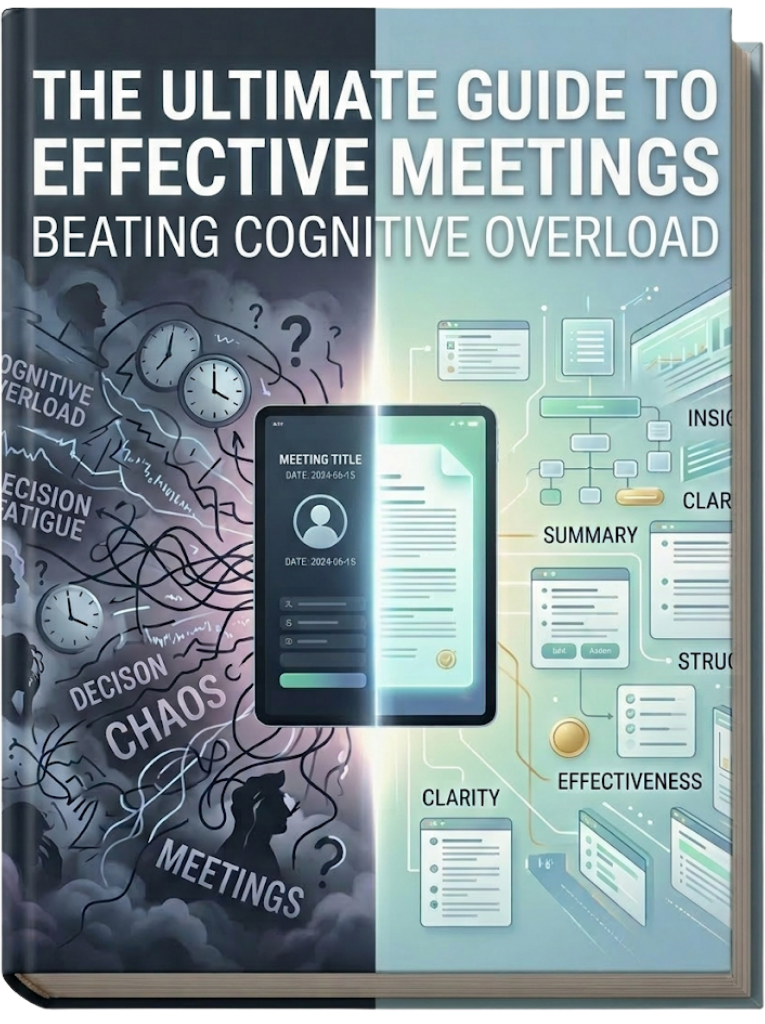
[!NOTE] Direct Answer: Modern meetings induce severe cognitive overload, reducing your functional IQ and decision-making capacity. Neuroscience proves the human brain cannot multitask or process more than four items simultaneously. TranscriptAI solves this biological bottleneck by securely automating transcription without ever training AI on your private data, restoring your mental bandwidth and productivity.
1. Why your brain hates modern meetings (The Attention Economy)
The tiny capacity of our working memory
The human brain is not a bottomless hard drive; it is a biological bottleneck. According to John Sweller’s Cognitive Load Theory, our working memory can only hold about four chunks of information simultaneously. When a high-stakes meeting introduces a fifth complex variable—like a budget, timeline, risk, or personnel—your neural architecture saturates. You literally drop data. Attempting to listen, analyze, and physically write all at once pushes your prefrontal cortex past its limits, inevitably causing cognitive overload in meetings. When this load peaks, your brain physically stops encoding new information into long-term memory to protect itself.
The destructive myth of Multitasking
You think you can listen to a stakeholder while typing meeting minutes. You cannot. Stanford University research proves that multitasking is a biological myth. The brain does not parallel process; it rapidly switches back and forth between tasks. This rapid toggling burns through oxygenated glucose in the prefrontal cortex and triggers cortisol release, putting your brain in a constant state of "fight-or-flight" stress. The biological cost is brutal. A University of London study found that this constant task-switching drops your effective IQ by 10 to 15 points. You are not "hustling" by doing two things at once; you are temporarily regressing to the cognitive capacity of an 8-year-old child.
The mental battery and decision fatigue
Willpower and decision-making capacity are finite resources. Psychologist Roy Baumeister conceptualized this metabolic exhaustion as "Ego Depletion". Every micro-decision you make drains your mental battery. Asking yourself how to phrase a sentence, what font to use, or whether you captured a detail correctly while taking manual notes forces you to make hundreds of useless micro-decisions.
By the end of the day, this chronic depletion leads to severe decision fatigue. You begin defaulting to the safest, easiest choices simply because your prefrontal cortex lacks the metabolic energy to strategize.
The solution is biological offloading. By delegating this extraneous cognitive load to TranscriptAI—a "Private by Default", SOC 2 Type II compliant platform that strictly enforces a zero-training policy on your data—you conserve your vital mental resources for high-level problem-solving and actual leadership.
2. The biological data leak: Why we forget everything
Project managers, your meetings are not failing due to a lack of discipline. They are victims of a neurobiological hemorrhage that you can actively stop.
The Forgetting Curve and brain cleansing
Your brain actively deletes your professional data. In 1885, psychologist Hermann Ebbinghaus proved that this degradation is both mathematical and brutal. Just one hour after a strategic meeting ends, your brain has already erased 50% of the precise information. Within 24 hours, that data loss reaches a staggering 70%.
This is not a malfunction. It is a biological survival mechanism designed to prevent cognitive overload by purging the system. The problem? Critical details—like technical constraints, budgets, and hard deadlines—hide within this deleted noise. By relying on manual notes, you will inevitably lose the battle against the Ebbinghaus forgetting curve.
The solution is to freeze the information immediately. TranscriptAI captures 100% of your exchanges with clinical precision and transforms that raw audio into structured data the exact second you hang up, securing your intellectual capital.
The Zeigarnik Effect and cognitive debt
You leave the office, but your mind is still spiraling over the meeting minutes you haven't written. Psychology calls this anxiety the Zeigarnik Effect. Discovered in 1927, this phenomenon dictates that our brains systematically remember unfinished tasks far better than completed ones.
Every delayed summary creates an "open loop" in your working memory. This loop consumes background metabolic energy, generates severe decision fatigue, and builds a heavy cognitive debt. To restore your focus, biology demands immediate closure.
TranscriptAI closes this loop for you. By transforming your conversations into a structured PDF action plan in two minutes flat, the app acts as your cognitive prosthesis. You close the loop before you even leave the boardroom, instantly freeing your mental bandwidth for the evening.
Dopamine and the power of immediacy
Sending a flawless summary to your client three days after a meeting is useless. The human brain massively devalues delayed rewards. Conversely, sending a structured summary with a clear action plan just 5 minutes after hanging up creates a powerful "wow effect".
This speed directly activates the reward circuit and dopamine in your client's brain. They will immediately associate your brand and profile with elite efficiency, reliability, and speed. Speed is not just a logistical advantage; it is a major psychological lever.
With TranscriptAI, you deliver this immediate value without ever compromising confidentiality. Thanks to our SOC 2 Type II certified infrastructure and our strict Zero-Training policy (Private by Default), your strategic data never feeds the AI models. You impress your clients while hermetically protecting their secrets.
3. The biology of negotiation and management (Social Psychology)
Oxytocin, mirror neurons, and eye contact
Leadership and sales rely heavily on neural synchrony. When you maintain sustained eye contact with a client or team member, you stimulate both oxytocin production and mirror neurons. This biological reaction fosters empathy, reduces social anxiety, and builds immediate trust.
However, the exact moment you look down at your keyboard or notebook to take manual notes, this neurochemical connection breaks. The client's brain shifts into a defensive or waiting state, severely damaging the psychological safety of the room. By delegating note-taking to TranscriptAI, you maintain uninterrupted eye contact, allowing your biology to close the deal and lead effectively while the AI discreetly handles the data capture.
Active listening vs. passive listening
There is a profound neurocognitive difference between hearing words and understanding meaning. Active listening defined by Carl Rogers demands total availability of your brain's processing power to decode semantic meaning, emotional tone, and non-verbal cues.
The physical act of writing or typing forces your brain into a state of continuous partial attention. You mechanically transition into passive listening; you capture mere words, but you entirely miss the underlying emotions and strategy. In high-stakes consulting or management, the true value lies in that unwritten emotion.
TranscriptAI acts as your external memory, freeing your cognitive bandwidth so you can engage in pure active listening and boost your retention from a passive 25% to over 70%.
The Amygdala Hijack and the fear of conflict
During a difficult HR reprimand, a crisis meeting, or a tense negotiation, your brain often misinterprets verbal challenges as physical threats. This triggers an amygdala hijack, an overwhelming emotional response where your brain's threat radar floods your system with cortisol and adrenaline.
Consequently, blood flow immediately shifts away from your prefrontal cortex—the area responsible for logic, memory, and executive function. You experience "mental fog" and temporarily lose up to 15 IQ points, making accurate manual note-taking chemically impossible.
TranscriptAI serves as your fail-safe. Knowing that a perfectly secure platform is capturing every word verbatim naturally soothes the amygdala, restoring your rational control and ensuring no critical legal or human details are lost in the panic.
The confirmation bias
The human brain is a filtering machine wired to protect its ego, not to record objective reality. When you take manual notes, you are highly susceptible to the cognitive confirmation bias. You unconsciously write down the signals that validate your pre-existing beliefs—like a client saying "yes"—while completely ignoring the critical nuance of "yes, but...".
Your handwritten notes become a distorted, biased interpretation of the meeting rather than a factual record.
TranscriptAI completely neutralizes this psychological trap. It provides a raw, 100% objective transcription of the reality without any emotional filter. Furthermore, because TranscriptAI is "Private by Default" with a strict zero-data-training policy and SOC 2 Type II compliance, you secure this unvarnished truth without ever exposing your strategic B2B intelligence to public AI models.
Conclusion: TranscriptAI, your Company's Cognitive Prosthesis
The Problem & Agitation
Your brain is not designed for the continuous multitasking demanded by modern meetings. Fighting your own biological architecture is a battle you will inevitably lose. Attempting to listen to a client, analyze their strategy, and manually transcribe the conversation triggers immediate cognitive overload.
The metabolic cost is brutal: a temporary drop in your operational IQ by 10 to 15 points, crushing decision fatigue by the end of the day, and the unavoidable loss of 70% of critical information within 24 hours. You do not lack discipline or rigor. You are simply saturating your finite neurological bandwidth.
The Solution
The answer is not learning how to take better notes. The answer is eliminating the act of manual capture entirely. TranscriptAI is not just another AI gadget; it is a true cognitive regulation interface. The application acts as a memory prosthesis that structures the noise.
By delegating the capture process to our technology, you instantly liberate your prefrontal cortex. Your raw conversations transform into flawless summaries and structured action plans the exact second you hang up. You can finally focus your mental energy on what actually matters: strategy, negotiation, and active empathy.
Proof & Reassurance
This cognitive liberation must never compromise your corporate secrets. Unlike intrusive meeting bots that harvest your conversations to improve their algorithms, TranscriptAI is built on a strictly "Private by Default" architecture. Our Zero-Training policy is absolute: your voice data and meeting minutes are never used to train our AI models.
Your intellectual capital is hermetically sealed using bank-grade AES-256 encryption on a fully SOC 2 Type II certified infrastructure.
Call to Action
Stop renting your brain out for basic data storage. Your true professional value lies in your executive decisions, not your typing speed.
Offload your mental burden today. Try the Freemium version of TranscriptAI: enjoy 100% free transcription with unlimited usage and absolutely no credit card required. Transform your complex conversations into concrete action plans with a single click.
Frequently Asked Questions
Why is it so exhausting to take notes while listening in a meeting?
According to neuroscience, the human brain cannot multitask or process more than four items simultaneously. Attempting to listen, analyze, and physically write all at once pushes your prefrontal cortex past its limits, inevitably causing cognitive overload. This constant task-switching triggers cortisol release and drops your effective IQ by 10 to 15 points. Furthermore, taking manual notes forces your brain into passive listening, making you miss critical emotional and strategic nuances.
How much information is actually forgotten after a meeting ends?
Human biology dictates a rapid loss of information known as the Ebbinghaus forgetting curve. Just one hour after a meeting ends, your brain has already erased 50% of the precise information. Within 24 hours, that data loss reaches a staggering 70%. While this is a biological survival mechanism designed to prevent cognitive overload, it means critical details like budgets and technical constraints will be lost if not captured immediately.
How does automating meeting summaries reduce stress?
Delayed summaries create "open loops" in your working memory, causing anxiety and decision fatigue known as the Zeigarnik Effect. TranscriptAI acts as a cognitive prosthesis by closing this loop for you. It transforms your raw conversations into a structured action plan the exact second you hang up. This immediate closure frees your mental bandwidth for the evening and allows you to focus your energy on high-level problem-solving and strategy.
Is it safe to use AI for confidential corporate meeting transcriptions?
Yes, provided the platform has strict privacy architectures. Unlike intrusive meeting bots that harvest conversations to improve their algorithms, TranscriptAI is built on a strictly "Private by Default" architecture. It enforces an absolute Zero-Training policy, meaning your voice data and meeting minutes are never used to train AI models. Your intellectual capital is fully protected using bank-grade AES-256 encryption on a SOC 2 Type II certified infrastructure.